
The Goblin Chronicle — As It Happened
The Goblin Chronicle — As It Happened
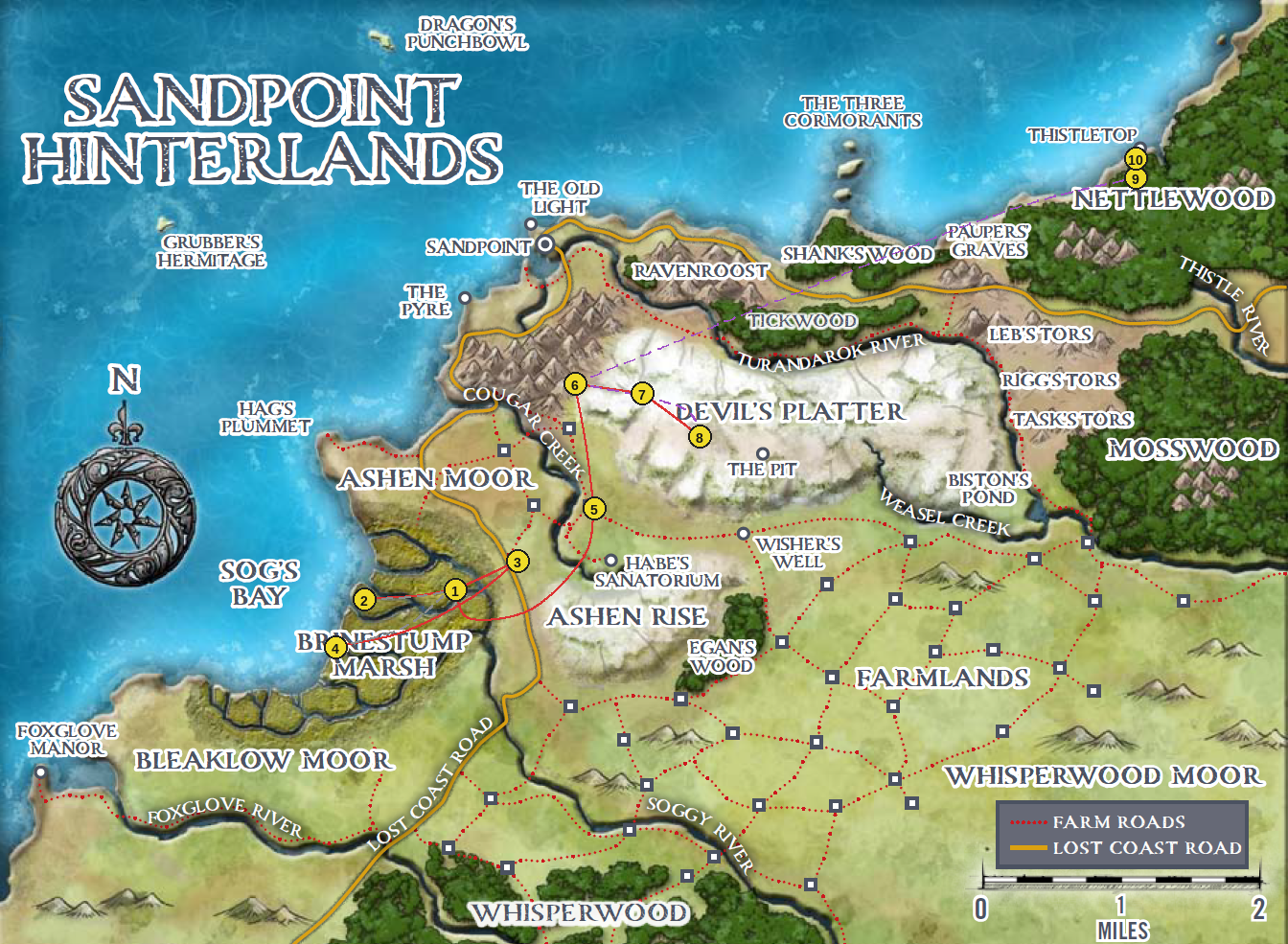
The route of the goblins — from Licktoad Village through Brinestump Marsh to Thistletop
The Goblin Chronicle — As It Happened
A true account of the greatest goblins who ever lived, which is all goblins, but especially these ones.
Part One: Cages, Dares, and a Very Dead Horse
It began, as the best goblin stories do, in a cage.
Four goblins crouched in the whelping enclosure of Licktoad Village — Bubble Bomb with her alchemical vials rattling against the bars, Rrrahah Bäähh muttering prayers to whatever deity would tolerate a Razortooth's teeth, Sneaky Scorch watching everything and touching nothing yet, and Shvub-Mah already measuring the distance to the latch. These four were the core of what would become the core party. The others came later. Stories always add names in retrospect.
The village elders had decided these four needed proving. So there were dares. There are always dares. The goblins proved themselves in the way goblins prove things: with fire, chaos, and a complete disregard for their own structural integrity. They were declared worthy. The cage opened. The Licktoad tribe had heroes, whether it wanted them or not.
Their first commission: a ship had run aground somewhere in the depths of Brinestump Marsh, and the tribe wanted to know what was on it. Simple enough, if the marsh cooperated, which it did not.
The path through Brinestump took them past a spider — not a small spider, not the kind that sends a sensible person to find a boot, but the kind that has opinions and the legs to enforce them. The four enforced their own opinions back. Shvub-Mah's acrobatics were, by all accounts, impressive. Bubble Bomb contributed something that exploded. The spider lost.
The river crossing required more finesse than violence, a ratio the party found uncomfortable but managed. Rrrahah Bäähh kept someone from drowning. This was to become a recurring contribution. The marsh then offered a crocodile, presumably as a test of character. The crocodile lost too, though with more splashing.
They came out at the coast as the sun died and the darkness rose off the water. The party made camp on the beach, posted no real watch, had some encounters that came out of the dark, and by morning were all still present, which counted as a victory. The ship waited.
What they found aboard was Vorka — a goblin cannibal of considerable local legend and worse dinner habits — and her horse. The horse died first, as horses do in goblin stories. Vorka died after, following a conversation that illustrated why goblins should not negotiate with other goblins who have already decided to eat them. The ship was thoroughly ransacked. The tribe would be pleased.
Returning through the marsh, they met an elf — Shalelu Andosana, a ranger who made it her business to know what was moving through this stretch of coast. She was not immediately hostile, which was unusual. They exchanged words. She mentioned a farm. A specific farm, a specific situation involving a pig. The party filed this away and continued home.
Part Two: The Pig, The Party, and the Burning
Licktoad Village celebrated. Goblins celebrate the way they do everything else — loudly, dangerously, and with fire that is technically controlled. The heroes of the marsh were feted, fed, and told they were magnificent, which they already knew.
Then someone noticed Squealy Nord was gone.
Squealy Nord was not just a pig. Squealy Nord was the pig — tribal mascot, spiritual animal, the pig whose squealing had soundtracked a hundred goblin songs. Gone. The celebration soured. The elders pointed, and pointed again: go to that farm the elf mentioned. Bring the pig back.
The farm was exactly what the elf had described: a human place, human-scaled, with a cage, and inside the cage, one very annoyed pig. The goblins of the Licktoad tribe excelled at exactly this — entering places they were not supposed to be in, taking things that were not supposed to be taken, and leaving before anyone could organize an adequate response. Squealy Nord was liberated. Some humans had a worse day than they had planned for. The party returned to the village trailing one pig and considerable self-satisfaction.
The second celebration was louder than the first.
Then the elders had another ship.
There is always another ship.
This one required a longer route, during which the party found a chest and within it a hilt — old iron, clearly part of something larger and more interesting than a hilt. Inside the hilt was a rolled paper with text on it. None of the four were stupid enough to read it yet. They carried both and continued, because goblins who stop to wonder about mysterious relics are goblins who miss the next fight.
On the return journey, they followed a trail that told a grim story: skeletons moving with purpose, and behind them or before them, the sign of a hero group — the worst kind of enemy, the kind that comes with noble intentions and blessed weapons and the absolute conviction that goblins deserve whatever happens to them.
They arrived at Licktoad Village. The fires were the wrong kind — not celebration fires, not cook fires, but the guttering remnants of a village that had been made an example of. Every goblin who had cheered them two nights ago was dead. The heroes were gone, satisfied with their work, leaving only bones that still moved with unfinished malice.
The four put down the skeletons. There was nothing else to do with that anger. Then they walked north, because south was ashes and there was nothing left behind them.
Part Three: Ashen Rise, the Ruined House, and a Tribe at the River
The road north through Ashen Rise was long and gray. They passed Habe's Sanatorium, visible from the path — a building that radiated the specific wrongness of a place where bad things are done to people with official paperwork. They did not stop. Shvub-Mah's eyes lingered on it. The others moved on.
Above the sanatorium, set back from the path where a ruin sat half-swallowed by the hillside, they stopped. This was Shvub-Mah's place — the fighter who had been doing acrobatics in and out of impossible situations since the spider encounter — and while "home" was perhaps too warm a word for a crumbling structure on a hill above a madhouse, it was theirs and they had come back to it. They rested. The marsh was far behind them. The next thing was ahead.
South again, and east, threading the passage between the mountains and the Devil's Platter — a wide flat of dark rock that sits in the landscape like something ancient trying to remember what it used to be. At the river, they found the Birdcrunchers.
The Birdcruncher tribe was the Licktoad tribe's counterpart on this side of the Hinterlands: goblins who had survived by being somewhere else when the heroes came. There were challenges, because there are always challenges when two goblin groups meet and need to establish something. The four passed them — Sneaky Scorch, in particular, passed all three rounds. There was a party. A bard, if the story had had one yet, would have been useful. The Birdcrunchers made do with what they had.
The Birdcrunchers had a task for them. There is always a task. This one led to Manschmied farm.
Part Four: Dead Spiders, Mountain Caves, and a Door Between Worlds
The farm was a stealth operation — not the Licktoad village's preferred mode, but Sneaky Scorch was in his element. Some of the farm's animals were already dead when they arrived, which suggested someone else had been through recently, or something. Pigs were freed. Some humans did not survive the encounter. The party left with what they came for and the unsettled feeling that they were following something, not leading.
The tracks confirmed it. They led away from the farm, into rising terrain, toward the kind of mountains that suggest caves at the top. They followed dead spider tracks until they found a dead spider — large, one of the nesting kind, killed by something that had moved on. The spider's trail continued up. They followed it.
At the peak of the climb, flanked by two stone pillars worn by weather into near-formlessness, the cave entrance waited. Inside: two paths diverging into darkness. They took the one that led toward the spider sign, toward the camp.
In the depths of the cave, through extended encounters with spiders of increasing ambition — including one that healed through its own adds, and an axe that took personal offense at the party's presence — they found the spider camp. And at the camp, something else entirely.
A device — strange-made, clearly not goblin-work, clearly not human-work — stood at the center. Bubble Bomb examined it. Then they used it.
The world did not end, but it went somewhere else.
By this point, the party had acquired one more member: Screech Sagg, found cocooned in the cave corridor by the spider population, who had also taken his boots. He had been waiting to be found. The bard, bootless, joined the group and was present when the world changed.
Part Five: The Astral Plane, and Rrrahah Bäähh's Dream
There was a tower. There was a cloud inside the tower, or the tower was inside the cloud, which amounts to the same thing when you are no longer certain which direction gravity runs. The six stood on the cloud and considered this, which is not a normal goblin activity.
Then they stepped off.
The astral plane received them with the profound indifference it extends to all travelers, and they floated through it — drifting, weightless, moving in a direction that felt like forward through space that had no clear opinion on the matter. The jungle was visible somewhere below and ahead: a dense green smear that promised something solid and alive.
Rrrahah Bäähh dreamed. Eyes open, floating, the Razortooth cleric dreamed something that left marks — not wounds, but the kind of residue that means something was seen that cannot be unseen. What was dreamed is Rrrahah Bäähh's to tell.
They came through into the Nettlewood jungle. Level 5. The trees were vast and old and did not welcome them. This was appropriate. They pressed on north.
Part Six: Thistletop
Thistletop is a headland that juts into the Varisian Gulf like a threat — topped with ruins, surrounded by enemies, connected to the mainland by a rope bridge over open water. The Nettlewood presses to its southern approach. The whole structure reads as a place designed to discourage visitors.
The six visited anyway, twice. Then came more.
The first time was reconnaissance with violence: sneak in, kill the enemies who presented themselves, learn the shape of the place, retreat before the shape of the place killed them back. They retreated to Birdcruncher territory, freed seven Birdcruncher prisoners from the Razertooth goblins along the way.
They came back knowing more. The second assault had a specific target: more Birdcruncher goblins were being held prisoner inside the walls. The party went in harder, freed their allies, and pulled back. On the return, they met Shalelu Andosana again — the same elf who had mentioned the farm, what seemed like a different world ago. This time she had a proposal: cooperate against the Lamashtu cult at Thistletop, and she would guarantee them entry to Sandpoint. The party was given a mission. Bring back the head of Nualia.
Now Uhuhh Shehee joined the party. The barbarian had been in the area — vibrating with pre-violence energy, which Thistletop seemed likely to require — and she was present for the third and final approach.
They went around, south along the cliff face, and descended to the sea caves at the base. The wereseal that guarded the passage died in water up to goblin necks, which made the killing less clean than preferred but no less final. They found treasure in the caves. They noted it and continued.
The bridge across to the island proper held their weight. The roof guards saw them coming and this was no longer a stealth operation. They died on the roof. The party went inside.
The interior was tight, layered, full of angles. Someone tried a climbing approach that required navigating around or over a human-orc figure with specific ideas about territorial defense. This encounter was resolved in the party's favor, though Uhuhh Shehee may have had more fun with it than strictly necessary.
The way down was a toilet shaft. Of course it was.
Part Seven: The Dungeon, the Prisoner, and the Temple
Below Thistletop's inhabited levels, the dungeon waited in old stone. The party found cages. In the cages: bears. Also, in circumstances that suggested she had been there for some time and was not pleased about it, Ameiko Kaijitsu — a person, not a monster, in the wrong place through someone else's choices. They talked. They freed her. She owed them something, which is the most reliable currency. She named the two ships: Kaijitsu Star, Kaijitsu Blossom. The officer on the Blossom. The brother who had put her here.
At the end of all of it, the Temple of Lamashtu.
Lamashtu is the Mother of Monsters: patron of goblin kind, goddess of nightmares and deformity, beloved by those who have nothing left to be beloved by. Her temple at the bottom of Thistletop was the final destination of a chain of events that had begun in a whelping cage in Brinestump, wound through burning villages and astral planes and one very memorable wereseal, and arrived here.
What happened in the temple was the last thing written down.
The eight goblins — Bubble Bomb the alchemist, Rrrahah Bäähh the dreaming cleric, Sneaky Scorch the rogue who touched everything now, Screech Sagg the bard whose songs improved under fire, Shvub-Mah the fighter who had come home to a ruin and kept going, Frizzel Brizzel the ranger who had ranged very far, Uhuhh Shehee the barbarian who had enjoyed all of this, and Wee Goo the fighter who had sat on someone at the start and ended here — were present at the last recorded encounter.
What came after, the ledger does not say. But eight goblins went in.
End of the known account.
What comes after: TBD at the table.